What a Shared MCP Gateway Solves—and What It Doesn’t
A metadata-driven MCP gateway can reduce repeated agent-to-dataset integrations, but discoverability is not authorization and a shared endpoint does not prove answer quality. Examine AWS’s architecture, the controls it reports, the limits of its latency evidence, and why realistic evaluation remains a separate job.
Editorial note · AI-assisted
AI-assisted original explainer; sources are listed at the end. Worked examples and exercises were not run unless marked as tested. Diagrams are AI-generated. The cover is an editorial photo.
Based on AWS’s 6 November 2026 engineering account and Microsoft Research’s 30 October 2026 evaluation account.

Key points
- A shared MCP gateway can centralize tool access and reduce repeated dataset integrations, but it does not make an agent’s answers trustworthy by itself.
- AWS’s design uses metadata files, optional context mappings, authentication, query restrictions, and a private server layer; those controls address different risks and should not be treated as interchangeable.
- The reported 15–20 second interaction time is a result from the AWS team’s testing, not a general latency promise or evidence of query correctness.
The integration problem is also a governance problem
When each AI agent connects to a data source through its own custom code, teams duplicate schema knowledge, query logic, and permission checks. That makes changes expensive and makes it harder to see where access decisions are enforced.
In a post published on 6 November 2026, Aishwarya Pawar, Sairam Vangapally, and Nitin Goyal describe an Amazon North America Sort Center system designed to put a shared Model Context Protocol (MCP) server between compatible clients and enterprise data tools. Its purpose is not to replace the data lake or the agent. It is to give different agents a common, controlled route to tools such as Amazon Athena, Amazon Redshift, and Amazon Bedrock Knowledge Bases.
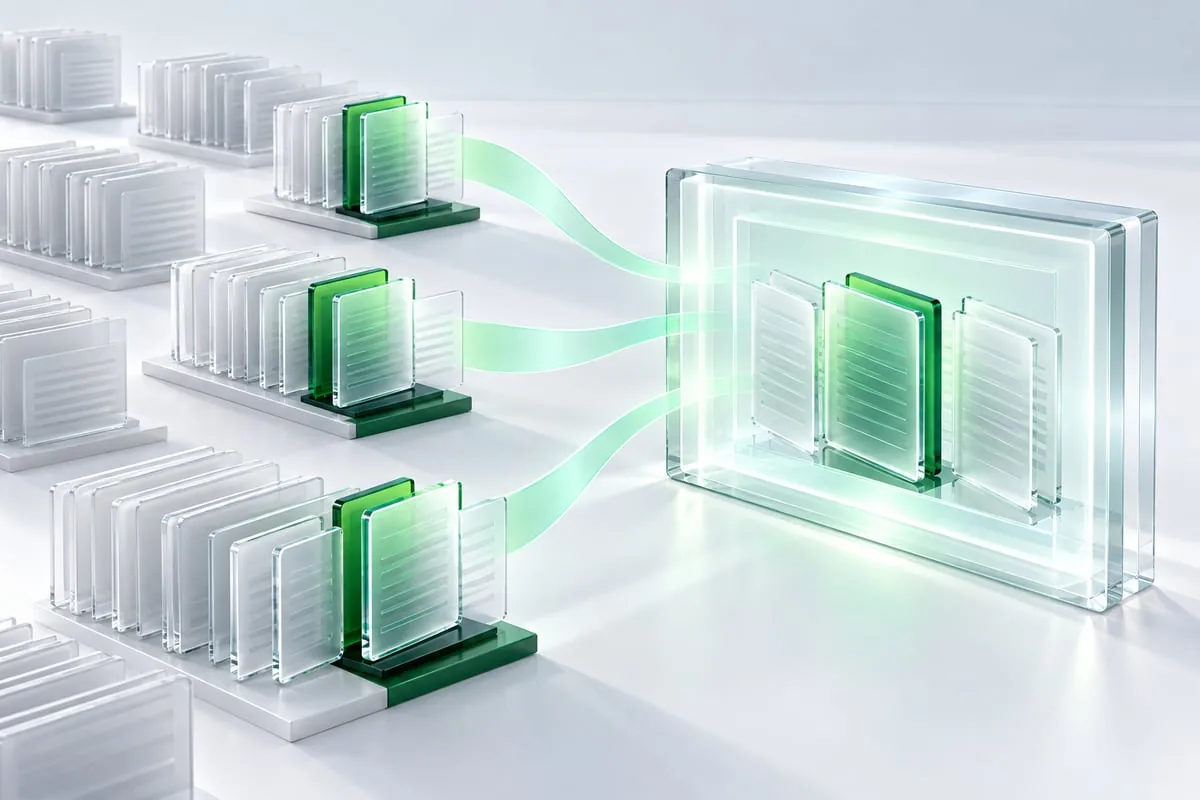
The central design choice is to separate the agent-facing tool interface from the dataset-specific description. A new table is represented by a JSON metadata file containing its schema, business meaning, column descriptions, sample values, and potentially engine-specific query guidance. A pipeline indexes that metadata; the authors say a dataset becomes discoverable after the next pipeline sync. This shifts some onboarding work from custom integration code into configuration and data description.
That is a useful architectural boundary: agents and orchestration frameworks can change without requiring every data source to be wired into each one again. But “discoverable” is narrower than “correctly queried,” and neither means “authorized for every user.”
What the gateway actually centralizes
The AWS account describes four layers: client, MCP server, tools, and knowledge-base refresh. The client layer handles user authentication and session storage. The MCP server orchestrates requests and exposes tools through a FastMCP-based endpoint. Backends perform SQL queries or semantic search, while a refresh pipeline indexes metadata.
The post describes several controls at distinct points in this flow:
| Design decision | What the source says it does | What it does not establish |
|---|---|---|
| Cognito authentication at the client layer | Validates user identity before requests are forwarded | The post does not document a full per-user, per-column authorization model |
| Private MCP server behind an internal load balancer | Keeps the server itself from being directly reachable from the internet | Network isolation alone does not establish that every request is appropriately scoped |
| SELECT-only Athena tools | Reject write operations before they reach the data lake | Read-only access does not prevent an authorized but incorrect or overly broad read query |
| Context mappings | Narrow metadata search to relevant tables when a context is supplied | Context is optional; without it, the agent searches across all indexed tables |
| Bedrock Guardrails on model interactions | Apply the team’s stated content-safety and grounding controls | The post does not report a measured prompt-injection success rate or prove that attacks are blocked |
| Structured CloudWatch logs | Provide a central record of tool invocations | Logging is not itself prevention, and the post does not report an audit evaluation |
This separation matters. Authentication answers who has presented a valid identity; context mapping helps choose what information is relevant; a query restriction limits the kind of operation a tool can perform. None alone answers whether a particular user should see a particular field. The authors say finer-grained restrictions for sensitive columns are a planned extension, which is a clear sign that the described design should not be mistaken for an already implemented column-level permission system.
Metadata is part of the query interface
A schema tells an agent that a column exists and what type it has. Business descriptions and examples can add details that conventional schema introspection misses: what a value means, how it is formatted, and which SQL convention applies.
The AWS post’s example metadata includes sample warehouse identifiers and a query hint for timestamp comparisons in Athena. These details can steer generated SQL toward the source system’s conventions. Context mappings can further limit the tables considered for a business domain. The trade-off is that metadata becomes operationally important. If descriptions, sample values, or hints are stale or misleading, an agent can confidently generate a query that is syntactically plausible but semantically wrong.
The system therefore relocates integration work; it does not eliminate it. Teams still need to maintain descriptions, review permissions, and check whether generated queries answer the intended question. The authors also describe a future feedback loop that would use failed or low-confidence queries to suggest metadata improvements. They present that as planned work, not as a capability already demonstrated in the post.
What the reported performance tells us
The authors report that context scoping kept end-to-end interaction latency in the 15–20 second range in their testing. They also report that an example end-to-end query flow completed within that range. Those figures are useful as a report of their system under their test conditions, but the post does not provide a benchmark workload, sample size, latency distribution, or a comparison against an unscoped baseline. It also does not establish that the system will meet the same timing under other data volumes, model choices, or concurrency patterns.
Nor is latency a measure of answer quality. The same post describes SQL validation and auto-correction, but it does not provide an accuracy evaluation showing how often generated queries are correct, complete, or appropriate for a user’s permissions. It reports architecture and an observed timing range, not an independent security or correctness assessment.
A related Microsoft Research account, published on 30 October 2026, makes a complementary point from the evaluation side: enterprise AI tests need realistic organizational context, time-dependent histories, and domain-specific workflows. Microsoft describes generating synthetic environments rather than using customer data, and reports improvements to its own internal quality measures. That work does not validate AWS’s gateway. It does illustrate why access architecture and evaluation are separate jobs: a system can make data available through a consistent interface, while teams still need representative tests to find failures in the answers and workflows built on top of it.
From demonstration to evidence
- Claim
What exactly is being claimed?
- Scope
Tasks · conditions · access
- Evidence
What can be reproduced?
When this pattern transfers—and when it does not
A metadata-driven MCP gateway is most compelling when multiple agents need access to overlapping datasets, integration code is being duplicated, and a team can maintain a reliable catalog. It can also create a more coherent place to apply shared tool-level controls and record tool use.
The pattern is less compelling if there is only one small, stable data source and the cost of operating a gateway exceeds the duplicated integration work. It is also insufficient where the core requirement is fine-grained authorization unless that authorization is explicitly designed and enforced beyond the controls described here. And metadata-driven onboarding is only as dependable as the pipeline that refreshes metadata and the process that reviews it.
The references are AWS’s engineering account, published 6 November 2026: https://aws.amazon.com/blogs/machine-learning/serverless-mcp-server-for-ai-agent-data-lake-access-on-amazon-ecs-fargate/ ; and Microsoft Research’s synthetic enterprise evaluation account, published 30 October 2026: https://www.microsoft.com/en-us/research/blog/from-synthetic-enterprise-data-evaluations-to-real-microsoft-copilot-ai-confidence/ .
Our verdict
A shared MCP gateway can make enterprise data access easier to extend and easier to govern by giving agents a common tool boundary and moving dataset knowledge into maintained metadata. The AWS design is a concrete example, not proof that centralization alone produces safe or accurate answers. Treat its identity, network, query, and logging controls as separate layers; verify authorization at the granularity your data requires; and evaluate answer quality with realistic tasks. The reported latency is encouraging for the authors’ test setup, but it cannot stand in for those checks.